
The Liminal in Color: Heruy Gebremariam & Dereje Weldegeorgis

DEREJE WELDEGEORGIS
Artist Statement
Early in his career, Dereje explored the mountainous landscapes of his homeland, using them as a foundation for his visual language. At the same time, he worked to develop an approach to proportion and stylization that engaged with, rather than replicated, Western artistic conventions. Over time, this led to a distinct aesthetic rooted in Ethiopian and broader African visual traditions.
While his recent works lean toward abstraction, they extend from his earlier explorations rather than marking a departure. His distinct visual language moves fluidly between figuration and abstraction, establishing a recognizable signature within the Ethiopian art scene and beyond.
His compositions build upon past themes, deconstructing and reassembling visual elements to create a dynamic balance. Through layering, fragmentation, and spatial manipulation, he constructs images where color, form, and structure interact in precise yet intuitive ways. His approach integrates rigorous experimentation with abstraction and semi-abstraction, pushing the boundaries of composition and materiality.
Dereje’s latest works demonstrate a heightened engagement with plastic elements—bold color intensity, the controlled dissection of the picture plane, and the residual presence of landscapes and figures. His practice is defined by a tension between structure and spontaneity, yielding works that are at once dreamlike, uncanny, and formally rigorous. Grounded in technical mastery, his evolving process continues to explore new possibilities within contemporary painting.
HERUY GEBREMARIAM
Artist Statement
Heruy Gebremariam makes figurative paintings shaped by memory, dreams, and his origins. Material and process matter to him as much as the image itself. He studied painting at Addis Ababa University’s Alle School of Fine Arts and Design.
Heruy works in acrylic, collage, and mixed media, moving between thin washes, scrubbing, and broad, thick impasto across a wide color range. Positive and negative space are never fixed in his work. Figures emerge from a dynamic ground, and the two trade roles throughout.
His paintings draw from memory, dreams, and myth. Recurring figures appear across his work, images he is still in the process of understanding.
Each painting is part meditation, part storytelling, and a way of sitting with experience without rushing to resolve it.
Stardust Is a Map
Artworks by Nichole M. Gray
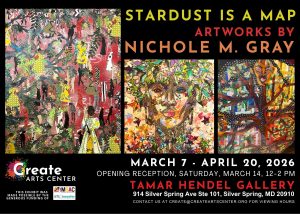
Stars appear as guides: the North Star, the heavens, cultural strength, and sometimes the borrowed language of the American flag. Hearts entered the work when my sister Heather fell ill with cancer- a fight she ultimately lost- becoming signs of life force: joy, energy, and love that refuse to disappear.
History is embedded throughout. In the work honoring Ida B. Wells, “strange fruit” trees reference lynching victims and the violence Wells documented in The Red Record, with red holding both bloodshed and testimony. Beneath the collage “Virginia 1619” are maps of the Deep South that trace the political geography of slavery, the Civil War, and the racial legacies that continue to shape the present.
Together, these materials and symbols form a kind of navigation. They honor the strength of my sister Heather, my best friend Sharon, who was the first friend I made at Wesleyan University. They honor my grandmother, who first placed fabric in my hands, and they honor the ancestors and goddesses who stand watch. Stardust becomes a language for what survives — a way of asking whether those we love are still out there, and answering that they are not gone, but moving, guiding, and returning in different forms.